
Reviewed · LILLE TOURS & ACTIVITIES
1 day Canadian WW1 private tour including Vimy Ridge
A walk on the Western Front, in Canadian context. This private day ties together Vimy Ridge with the trench lines, memorial design, and nearby cemeteries in a way that feels practical, not just emotional. I love the small-group format and the live, on-the-road explanations, but be aware it is a long day with heavy subject matter.
You start at the Vimy Ridge visitor area, then move through Canadian sites and onward to the Somme sector, including Beaumont-Hamel and the Newfoundland memorial area. The big plus is that you are not stuck with a generic bus script, you get help placing what you see into the bigger battle picture. One drawback to consider is that lunch is not included, so you will want to plan your timing and budget.
In This Review
- Key points before you go
- Why this Canadian WW1 route hits differently
- Vimy Ridge visitor centre, trenches, and the Grange Tunnel option
- Walking from Canadian positions to the memorials that frame the story
- The Somme switch: Pozières and Beaumont-Hamel after Vimy
- Beaumont-Hamel: the Danger Tree, Caribou Memorial, and trench reality
- Courcelette Canadian Memorial and the link to tanks on the Somme
- Private, up to 3, with a driver-guide and live commentary
- Price and what you get for $372.43 per person
- Logistics you should plan for on a full Western Front day
- Who this tour suits best
- Should you book this Canadian WW1 private day?
- FAQ
- How long is the Canadian WW1 private tour including Vimy Ridge?
- What is the start time?
- Is lunch included?
- What sites are included besides Vimy Ridge?
- Is the Grange Tunnel visit always included?
- What type of group is it?
- Do you get picked up from your hotel or train station?
- Is there bottled water on the tour?
- Is admission included for the stops?
- What is the cancellation policy?
Key points before you go
- Private small group up to 3 with live commentary, so you can ask questions without shouting over a crowd
- Vimy Ridge plus trench history, including the walk through no mans land between Canadian and German positions
- Grange Tunnel is conditional, added depending on attendance and time
- Newfoundland focus at Beaumont-Hamel, with the well preserved trench system, plus the Danger Tree and Caribou Memorial
- Route connects Arras and the Somme, with stops that link tactics, units, and key dates
Why this Canadian WW1 route hits differently
WWI battlefield tours can go two ways. Either you get a pile of facts at monuments, or you get the sense of how soldiers actually moved through broken ground. This day leans hard toward the second option, and it does it with a Canadian lens.
You get a tight loop of sites around Arras, Vimy Ridge, and the Somme, so your brain can build a timeline instead of bouncing from one landmark to another. It also helps that the tour is built for a private group. That means the guide can pace you, slow down when you have questions, and point out what matters at each stop.
If you care about Canadian participation in WWI, this itinerary makes that easy. You are not just looking at French soil, you are seeing how Canadian units, memorials, and commemorations are stitched into the story of the Western Front.
Still, go in prepared. This is a day about death, grief, and mass casualties. Even if you are history-minded, you may find the cemetery stops and memorials emotionally heavy.
Other Lille bookings to consider
- Vieux Lille 2-Hour Guided Walking Tour
★ 4.5 · 1,220 reviews - Entrance Ticket Nausicaa, the biggest aquarium in Europe
★ 3.5 · 1,135 reviews - Lille Bus Tours
★ 4.4 · 1,133 reviews
Vimy Ridge visitor centre, trenches, and the Grange Tunnel option
Your day begins at the Canadian National Vimy Memorial area. The first stop is the Vimy Ridge visitor centre, where you set context before walking the ground. That matters because Vimy is not just one hill. It is a designed battlefield landscape, shaped by trenches, angles, and the hard logic of artillery and observation.
From there, the tour may add a visit to the Grange Tunnel. The plan is conditional, meaning it depends on attendance and timing. If it is available, you get an “under the surface” look at how soldiers moved and lived while still under threat. If it is not, you still get the main Vimy experience, but without that extra trench-side perspective.
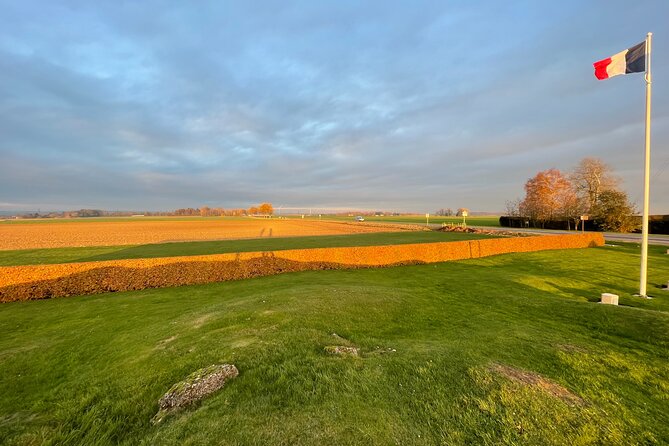
One of the standout parts of Vimy in this tour style is the movement through the battlefield space itself. You cross through no mans land and walk facing the German trench system while positioned toward where the Canadian lines were. Even when you know the history, standing where it happened forces your mind to work differently. Distances feel real. Sight lines feel real. The scale stops being abstract.
Practical note: you will be doing outdoor walking on uneven terrain. Wear comfortable shoes and dress for the weather, because this is a battlefields day, not a museum only day.
Walking from Canadian positions to the memorials that frame the story
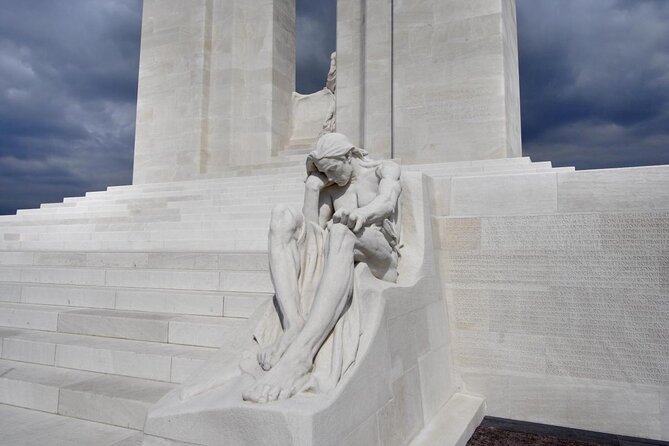
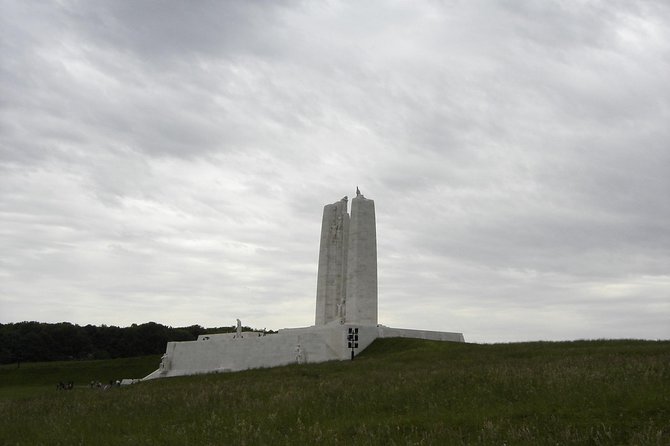
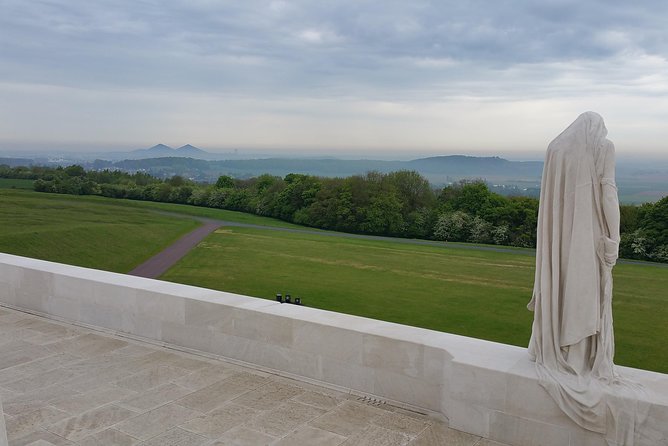
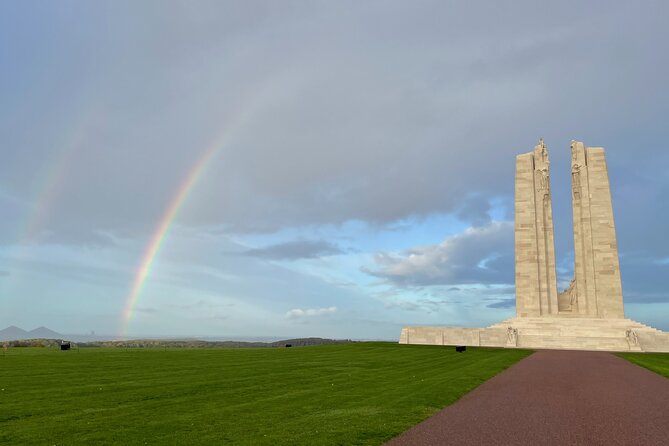
After the trench walk, the tour shifts into what memorials do best: turning chaos into a readable narrative. You then drive to the Canadian Memorial, designed by Walter Seymour Allward and refurbished in 2007.
Allward’s memorial design is worth your time because it is not just a plaque moment. It is built to make you look up and out, and to understand that commemoration is part architecture, part symbolism. On a battlefield day, that visual shift is useful. It gives your eyes somewhere to rest after the hard ground and tight trenches.
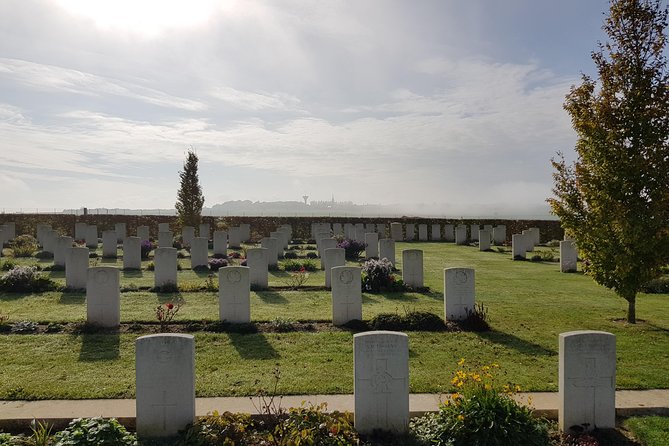
Before you leave this Vimy area phase, you stop at the Givenchy Road Canadian Cemetery. This is a smaller but powerful site, containing the graves of 108 Canadians who fell on 9 April and the days that followed during the battle phase. The admission is free, and the time here is short, which can be good. When you have limited time, you are less likely to lose focus.
This combination works well. You see the living battlefield layout first, then you move to burial and commemoration. That order helps the day feel coherent instead of random.
The Somme switch: Pozières and Beaumont-Hamel after Vimy
Once you finish the Vimy and Arras-sector stops, the tour shifts toward the Somme. The big advantage of this sequencing is that you do not treat the war like separate chapters. You keep building the same mental map: units, timing, terrain, and why tactics mattered.
Your next break is at Pozières for lunch time in a local cafe or restaurant in the La Boisselle or Pozières area. The tour provides time for this, but lunch is not included, so it is on you to choose what fits your appetite and pace that day.
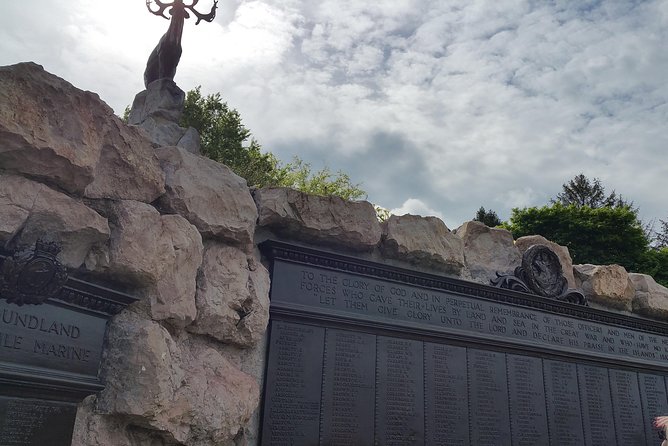
Then you head to the key emotional and educational anchor of the Somme portion: Memorial Terre-neuvien de Beaumont-Hamel. This is tied to the Newfoundland story and the first day of the battle of the Somme, where the Newfoundland regiment suffered the second worst casualty level of a regiment on that day.
Within easy reach:
- Lille Driving Tour by Convertible Citroen 2CV
★ 4.9 · 711 reviews - Unique Tour of Lille by Convertible 2CV – 1h00
★ 5.0 · 470 reviews - Lille: Entry ticket to the Museum of Illusions
★ 4.1 · 307 reviews - Lille: 24, 48 or 72-Hour City Pass & 24-Hour Transportation
★ 4.3 · 205 reviews
Beaumont-Hamel: the Danger Tree, Caribou Memorial, and trench reality
Beaumont-Hamel is where this tour becomes more than a sightseeing circuit. You get access to a well preserved trench system, and that is the point. Trench warfare can sound like a concept until you stand where men would have had to move, wait, hide, and survive in cramped, exposed conditions.
Facing the German army line, you can see the Caribou Memorial and the Danger Tree area. Those features help you connect names to place. They also reinforce the idea that some sites were preserved because they keep the shape of the story intact.
The time allocated is about one hour at this segment. That is enough to walk the ground, take in the key memorial points, and get the guided context without turning it into a rushed sprint.
If you are traveling as a Canadian history fan, this stop tends to land hard because it is specific. It is not just “the Somme was awful.” It is the Newfoundland experience at Beaumont-Hamel, and that specificity makes the history easier to hold in your head.
Courcelette Canadian Memorial and the link to tanks on the Somme
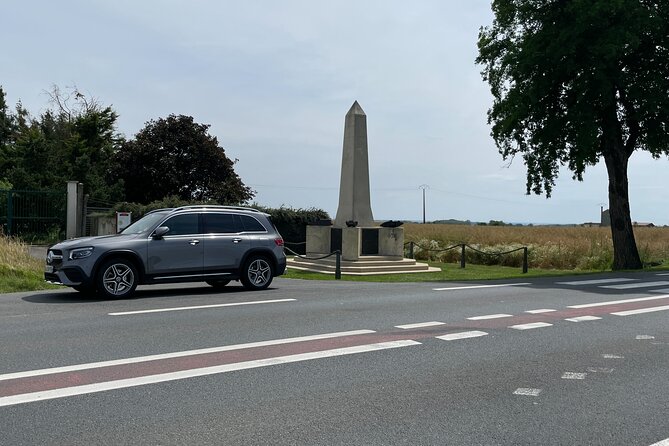
After Beaumont-Hamel, you move to the Canadian Memorial of Courcelette. This section brings the story back to another Canadian operational moment during the battle of the Somme in 1916.
There is a key detail here that helps with understanding: Courcelette is associated with the mid-September 1916 capture of the village and the fact that tanks were used for the first time in history on the same date. Even if you know the headline, having it in the right place makes the idea feel concrete.
You will only have about 15 minutes at this stop. That might sound short, but on a day like this, it can actually be efficient. It keeps your energy for the earlier Vimy and the heavier Beaumont-Hamel portion. If you want more time here, that is exactly the type of question you can ask your guide.
Private, up to 3, with a driver-guide and live commentary
The tour runs with private transportation and a driver/guide, in a small-group format up to 3. That group size is part of the value. You get live commentary, and you are not forced into a rigid pace that works for the biggest group.
In the feedback shared by guests, Olivier is repeatedly praised for organization and for explaining battles in a way that ties the road, the timeline, and the ground together. One especially helpful detail is that he uses historical maps displayed via the car GPS system. That matters because you are not just hearing facts. You can see the front line movement in context while the scenery and distances pass by.
You also get bottled water, and the day is designed to be doable for most people. If you are traveling with kids, the rule is simple: children must be accompanied by an adult.
If you are coming from elsewhere and need pickup help, the tour offers pickup flexibility in the Amiens, Arras, and Saint-Quentin areas. Start time is 9:30 am, and pickup is arranged after booking based on your preferred location.
Price and what you get for $372.43 per person
At $372.43 per person for a roughly 7-hour day, this is not a budget group tour. But it can be good value if you compare apples to apples.
You are paying for:
- a licensed local guide and live commentary
- a private vehicle for transportation between multiple battlefield zones
- a format built for small groups up to 3
- free admissions at multiple stops listed as free
- bottled water
If you have a group of two or three traveling together, the per-person cost can feel more reasonable because the guide and vehicle are shared. Even as a solo traveler, the private format can be worth it if you want explanations tailored to what you care about, especially the Canadian angles at each site.
The one clear cost to plan for is lunch. Since lunch is not included, your total day cost will depend on what you choose at the cafe stop near Pozières or La Boisselle.
Logistics you should plan for on a full Western Front day
This is a car-based day with multiple outdoor stops. That means you should plan for the basics.
Wear:
- comfortable shoes for uneven ground
- layers for shifting weather
Bring:
- a phone or small camera for memorial details (you will want to take your time at the cemetery and at key memorial points)
Also, note the pickup origin limitation: the tour cannot originate from Paris, due to distance and time constraints. That affects how you stage your day if you are using Paris as a base.
Start time is 9:30 am, and confirmation is received within 48 hours, subject to availability. This is helpful if you like to plan but still keep flexibility.
Who this tour suits best
This is a strong match if you are:
- Canadian, or you want a Canadian WWI focus
- interested in trench warfare and how soldiers moved through it
- the type of traveler who likes maps and guided explanation, not just monuments
- traveling with one other person, where the small-group format feels especially efficient
It may be less ideal if you:
- want a quick highlight-only day with minimal walking
- prefer a casual, low-intensity tour with no emotional weight
If you fall into the middle, the guide’s pacing and the mix of cemetery, trench layout, and memorial design usually makes the day feel balanced.
Should you book this Canadian WW1 private day?
If your priority is to understand Canada’s WWI battlefield story around Vimy Ridge and the Somme, I would book it. The combination of Vimy trench context, the Walter Seymour Allward memorial, and the Newfoundland stop at Beaumont-Hamel gives you a day with clear focus instead of random stops.
I also like that you have time built in for meaning. You are not rushed through everything at maximum speed. And with a small group, you are more likely to get answers to the questions that pop up once you start seeing the lines and distances for real.
Just go in with your expectations set: it is a long, moving day about war. Bring comfortable shoes, plan for lunch on your own, and give yourself permission to feel what these sites are designed to communicate. If that sounds like your kind of trip, this is a worthwhile Canadian WW1 experience to put on your calendar.
FAQ
How long is the Canadian WW1 private tour including Vimy Ridge?
It runs for about 7 hours.
What is the start time?
The tour starts at 9:30 am.
Is lunch included?
No, lunch is not included. There is a lunch break in the La Boisselle or Pozières area.
What sites are included besides Vimy Ridge?
You visit the Canadian National Vimy Memorial area, Givenchy Road Canadian Cemetery, Pozières for lunch, Memorial Terre-neuvien de Beaumont-Hamel, and the Courcelette Canadian Memorial.
Is the Grange Tunnel visit always included?
It will be added depending on attendance, so it is conditional.
What type of group is it?
It is a private tour/activity, with a small-group format of up to 3 participants only.
Do you get picked up from your hotel or train station?
Pickup is offered and is arranged after booking. Pickup is flexible within the Amiens, Arras, and Saint-Quentin areas.
Is there bottled water on the tour?
Yes, bottled water is included.
Is admission included for the stops?
Admission tickets are listed as free for the key sites mentioned, including the cemetery and memorial stops.
What is the cancellation policy?
Free cancellation is available if you cancel at least 24 hours before the experience start time for a full refund.
Newly listed around Lille
- 30-Minutes Private Guided Tour of Lille by Convertible 2CV★ 5.0 · 79 reviews
- 1 Hour Private Lille Tour by Convertible 2CV with a Local Products Tasting★ 5.0 · 78 reviews
- Lille : Private Custom Walking Tour With A Local Guide★ 4.5 · 18 reviews
- Australian Battlefields Private Tour in Fromelles and Flanders from Lille★ 5.0 · 22 reviews
- Private Lille Tour by Classic Convertible 2CV with Champagne★ 5.0 · 49 reviews
- Self Guided Secrets Tour Explore Lille and Miss Nothing★ 4.0 · 22 reviews
- Rallye “Discoveries and Surprises”★ 5.0 · 52 reviews
- Lille Scavenger Hunt and City Highlights Walking Tour★ 4.5 · 47 reviews
Lille Tours & Activities, compared.

Entrance Ticket Nausicaa, the biggest aquarium in Europe
Read our review →

24, 48 or 72-Hour City Pass & 24-Hour Transportation
Read our review →
Private Round Trip Transfer to Vimy Ridge from Arras
Read our review →Browse the lists this tour appears in