
Reviewed · MONTMARTRE WALKING TOURS
Experience Paris’ Village of Montmartre away from the crowds
Montmartre can be a zoo, unless you plan well. This walk is interesting because it keeps you moving through small-group streets and hits the biggest sights with better timing, like Sacré-Cœur and Moulin Rouge. I like the way the guide brings fun, specific history to real corners of the neighborhood, and I also like that you get time for calmer backstreets instead of only photo stops. The one drawback is simple: it is hilly and walk-heavy, so pace matters if you tire easily.
With a duration of about 1 hour 30 minutes and English guidance, you get a focused hit of Montmartre without paying for museum entrances. You also start near BlancheParis and finish at the Sacré-Cœur area, which is handy if you want to keep exploring after the tour. Just keep in mind that the experience does not go inside buildings, so your payback is in the street-level stories and viewpoints, not indoor exhibits.
In This Review
- Key reasons this Montmartre walk works
- Why Montmartre feels calmer when you skip the rush
- Meeting at BlancheParis and ending at Sacré-Cœur
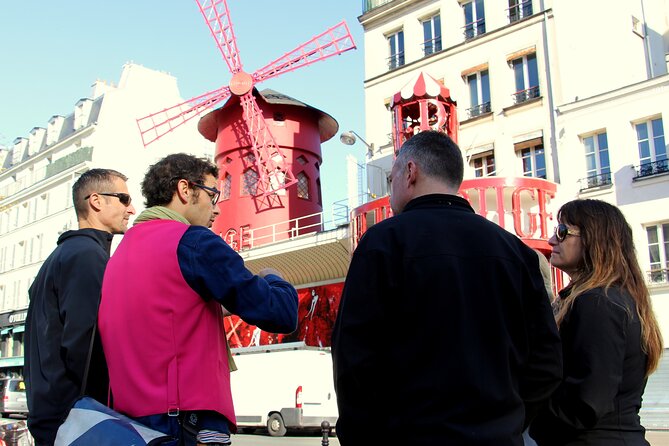
- Moulin Rouge: more than a famous facade
- Montmartre Village backstreets: the “old Paris” feeling you can walk through
- Le Moulin de la Galette: windmill photos with art-historical context
- Place du Tertre: artists at work, not just artists as a concept
- Vigne du Clos Montmartre: the tiny vineyard and the Sacré-Cœur sightline
- Sacré-Cœur finale: the classic view, handled with guidance
- Price and value: why $18.10 makes sense
- The walking reality, plus one operational caution
- How to get the most from your guide (and your short stops)
- Who should book this Montmartre walk?
- Should you book it?
- FAQ
- How long is the Montmartre walk?
- What is the price per person?
- Is the tour in English?
- How big is the group?
- Where does the tour start and end?
- Do we enter any museums or buildings?
- Is a mobile ticket provided?
- Can I bring a service animal?
- What is the cancellation window?
Key reasons this Montmartre walk works
- A real small group (max 21) so you are not stuck listening from the back
- Better crowd timing for Moulin Rouge and the Sacré-Cœur area
- Street-level art connections, from cabaret history to the places linked with famous painters
- Short time blocks (around 10 minutes at each stop) that keep you moving efficiently
- A rare local stop at Vigne du Clos Montmartre, plus an “it’s right there” Sacré-Cœur view
- Guides with humor and Q&A energy, including Anaelle, Harry, and Alexandre names that show up in the feedback
Why Montmartre feels calmer when you skip the rush
Montmartre is one of those Paris neighborhoods where people come for the look, but stay for the personality. The trouble is the look comes with long lines and crowded sidewalks. What I like about this tour style is the way it helps you beat the crush without feeling rushed.
You start with Moulin Rouge, then you flow into older streets and artist-focused squares. That rhythm matters. It is much easier to understand what makes Montmartre feel like Montmartre when you are walking the actual routes and hearing why each place mattered, not when you arrive at every stop with a crowd pressing in around you.
Also, the tour is built for attention. Each location is handled in short, meaningful segments, roughly 10 minutes per stop, so you get enough time to notice details while the guide ties them into the bigger story of the neighborhood.
More Montmartre climbs:
- Montmartre Hidden Gems and Scenic Highlights Walking Tour
★ 5.0 · 2,684 reviews - Montmartre Hill French Gourmet Food and Wine Tasting Walking Tour
★ 5.0 · 2,588 reviews - Paris: Montmartre Highlights Walking Tour with a Local Guide
★ 4.9 · 2,318 reviews
Meeting at BlancheParis and ending at Sacré-Cœur
The tour starts at BlancheParis, and it ends at the Basilica of the Sacred Heart of Paris (Sacré-Cœur Basilica), 35 Rue du Chevalier de la Barre. That end point is ideal because Sacré-Cœur is usually the moment people want to see at the end, when they can slow down and absorb the city views.
You get a mobile ticket, and it runs in English. It is also close to public transport, which makes it easier to plug into a day of museum hopping or a simple afternoon around the 18th arrondissement.
One practical thing to remember: because the walk climbs and descends through Montmartre streets, you will feel it in your legs more than in your schedule. Plan for comfortable shoes and a steady pace. If you are bringing anyone with mobility limits, keep that hill factor in mind.
Moulin Rouge: more than a famous facade
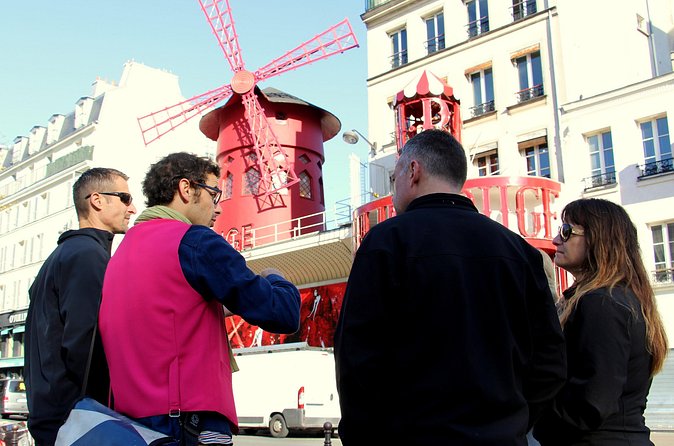
Moulin Rouge is instantly recognizable, and that is exactly why it is a smart first stop. The guide frames it as the ultimate symbol of bohemian Montmartre, not just a poster on a postcard.
You will also hear the story of Toulouse-Lautrec and why he spent time painting around the cabaret world. The useful part is that the guide turns that name into something you can connect to what you see around you: dancers, clients, and the cabaret atmosphere that became part of his famous imagery.
Because the stop is short, you should show up ready to look. Spend the time checking the angles, the street setup, and the feel of the place before you move on. If you only do Moulin Rouge as a quick photo, you miss the whole point of starting here.
Montmartre Village backstreets: the “old Paris” feeling you can walk through
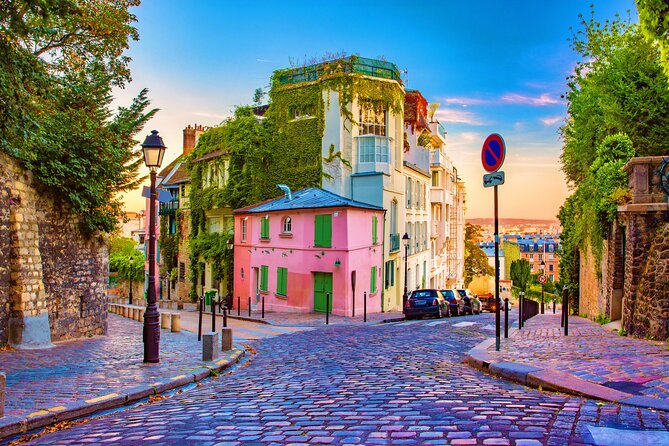
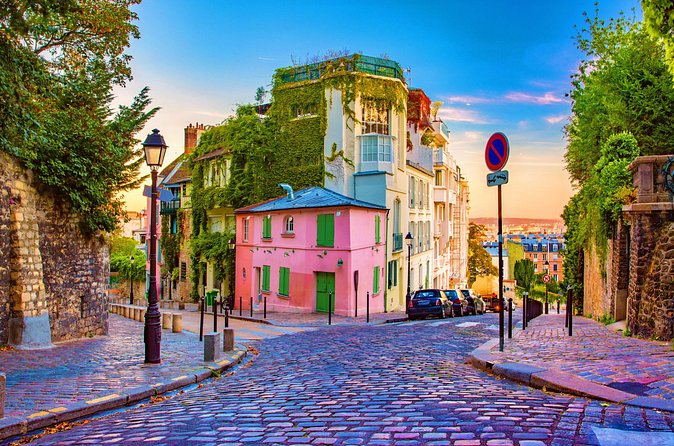
After Moulin Rouge, the tour shifts into the quieter heart of the neighborhood: Montmartre Village. This is where you trade broad boulevards for narrow, cobblestone streets, with buildings that look grown-in rather than staged for tourists.
You will pass ivy-covered façades and tucked-away gardens, and the vibe is cozy and bohemian in a way you can actually feel at walking speed. The guide also ties this space to the artists who helped shape Montmartre’s reputation, including names like Picasso and Modigliani.
What I like most here is that this part of Montmartre is easier to understand through stories. If you know why a courtyard, a square, or a lane mattered to artists and revolutionaries, the neighborhood stops being just scenery. It becomes a place with layers.
Other Paris bookings to consider
- Paris: 1-Hour Seine Cruise departing from the Eiffel Tower
★ 4.4 · 77,472 reviews - Disneyland® Paris 1-Day Ticket
★ 4.6 · 49,412 reviews - Paris: Versailles Palace and Gardens Full Access Ticket
★ 4.6 · 41,579 reviews - Paris: Arc de Triomphe Rooftop Tickets
★ 4.6 · 34,264 reviews
Le Moulin de la Galette: windmill photos with art-historical context
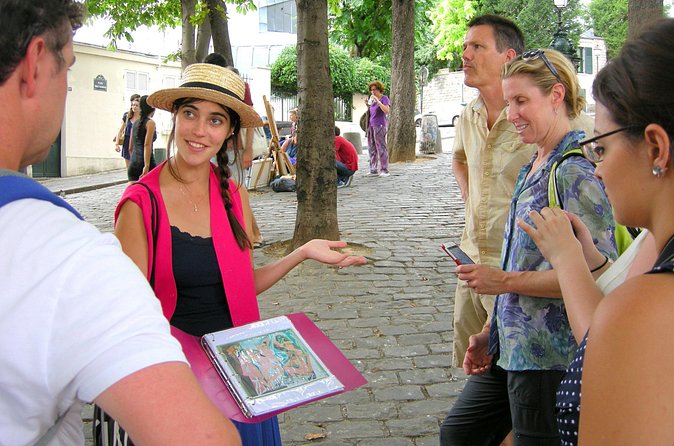
Next comes Le Moulin de la Galette, a spot people recognize for the windmill, but the guide gives you a reason to care beyond the photo. The windmill is tied to Montmartre’s past as a dance hall, and it is also linked to artistic inspiration connected to Renoir and Van Gogh.
Even if you are not a deep art-history person, the guide helps you understand what you should notice. You learn how the same setting can mean different things across time: entertainment for one era, art for another, and today, a snapshot of 19th-century Paris you can still walk around.
This is also a good place for a reality check. Windmills and picturesque streets can tempt you into stopping too long. The tour keeps it moving, so you see this stop as a highlight without letting it swallow the whole afternoon.
Place du Tertre: artists at work, not just artists as a concept
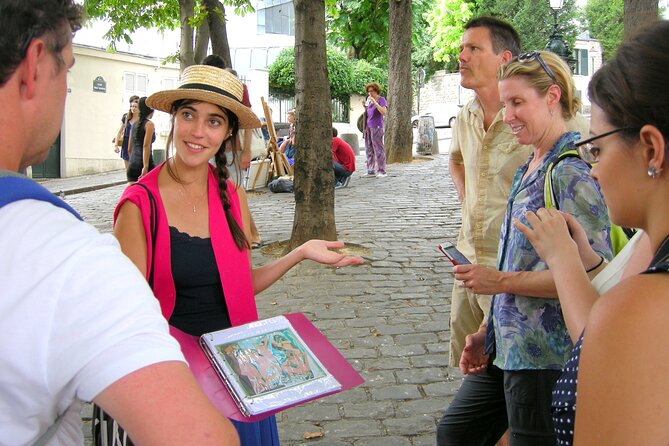
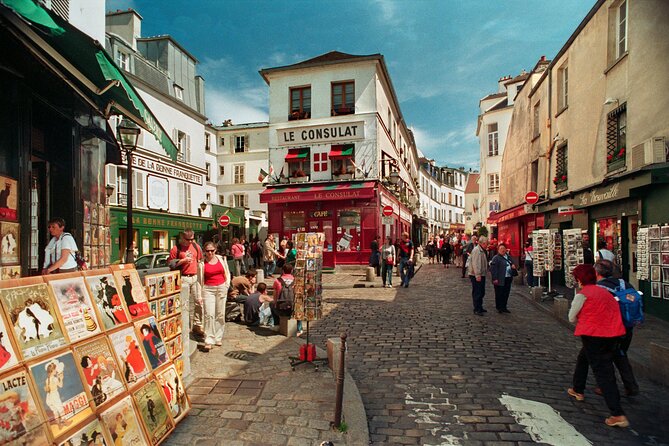
Place du Tertre is often called the Artists’ Square, and the best part is that it is not just a name. Local artists work there, and you can watch them put the final touches on paintings.
You might see portrait drawings too, and caricature work is offered if you are game. The guide’s role here is to help you read what you are seeing, so it feels less like browsing and more like watching a living craft in action.
If you want to buy art, take a minute to do basic shopping sense: ask questions, look at the paper or canvas, and decide calmly. These stalls are designed to encourage quick decisions, so your best move is to slow down for one conversation and one look before you commit.
Vigne du Clos Montmartre: the tiny vineyard and the Sacré-Cœur sightline
Then the tour goes to Vigne du Clos Montmartre, where locals keep their own vineyard plot. This is the kind of stop that feels almost impossible to find on your own, and that makes it especially valuable if you like places that do not show up in every basic walking route.
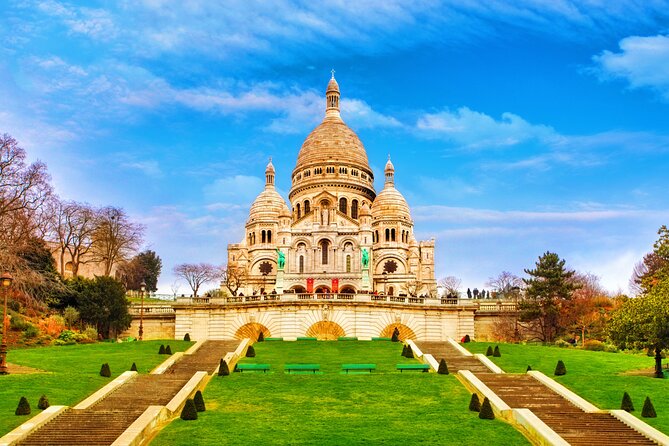
The plot is small, but the view is the big payoff. You get vines in the foreground with Sacré-Cœur in the background, and it helps you see the church not only as an icon, but as a geographic anchor in the neighborhood.
The stop is also a good reminder of Montmartre’s contrast: a neighborhood packed with crowds and cafés, and just a few steps away, something more practical and local, shaped by seasons and cultivation.
Sacré-Cœur finale: the classic view, handled with guidance
The last stop is Basilique du Sacre-Coeur. This is the world-known icon, all white and bright against the sky, with Paris spread out in front of you. The guide gives you context for what you are seeing, which makes the moment more than a standard skyline photo.
Since you are finishing here, you also benefit from being pointed toward how to enjoy the area when you arrive. People tend to rush to the most obvious viewpoints, but the guide helps you see where the sightlines and story fit together.
One thing to plan around: dress for the church and the time of day. Even when the tour does not go inside buildings, you still end up in the Sacré-Cœur zone, and that area can mean cooler air and more wind at higher elevations.
Price and value: why $18.10 makes sense
At $18.10 per person for about 1 hour 30 minutes, this tour lands in the budget-friendly zone for a guided Montmartre experience. You get an expert guide, a small group, and both main landmarks and quieter stops.
You also do not pay for museum entry because the walk is designed around exterior viewpoints and street-level landmarks, not inside exhibits. That matters because it keeps your cost controlled and your time focused on what you can see right away.
The group size is capped at 21 travelers, and the small-group feel shows in the way stops are managed. It is easier to ask questions and get responses when your group is not enormous.
There is also a planning signal built into the numbers: on average, the tour is booked about 33 days in advance. That usually means demand is steady, so if you have a narrow window in Paris, you should not wait until the last minute.
The walking reality, plus one operational caution
Montmartre always has stairs and steep bits. This tour is not described as an easy stroll, and an older-visitor review flagged that there is too much walking for elder persons due to the ups and downs. I agree with that warning in general terms: if mobility is limited, you will need to manage pace, rest, and expectations.
On top of that, there is at least one serious negative note in the feedback: a no-show issue where the guide reportedly did not arrive and calls were not answered. That kind of incident is rare, but it is worth taking seriously. Your best protection is practical: show up early, confirm the meeting point, and be ready to contact the operator promptly if anything seems off.
How to get the most from your guide (and your short stops)
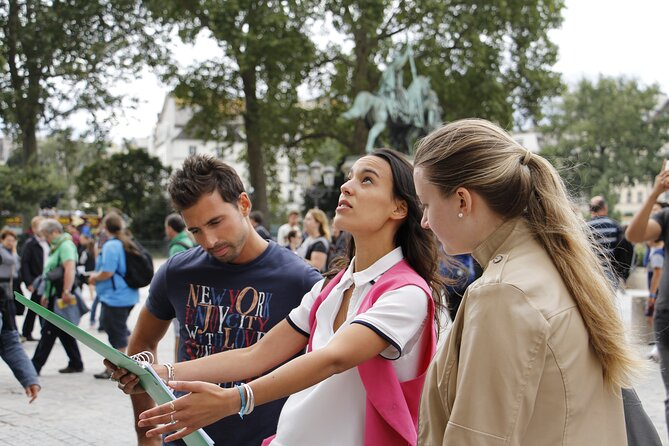
The biggest strength in the feedback is the guides themselves. Guides including Anaelle, Harry, and Alexandre are described as engaging, funny, and strong on history details. That style is not fluff. It is what turns a place you already recognize into a place you actually understand.
Here are a few tactics to make the tour pay off:
- Ask questions about what you are currently standing in front of, not only the next stop
- Pay attention to the artist names the guide connects to specific corners, squares, and landmarks
- If you have a specific goal, like best time for photos or where to eat nearby, ask for the practical recommendations while the guide is with you
Also, keep expectations matched to the format. You are not doing museums. You are doing a guided street route with short, high-impact stops.
Who should book this Montmartre walk?
This is a great fit if you want:
- A first-time Montmartre orientation that avoids a fully chaotic experience
- A guided connection between artists, cabarets, and neighborhood streets
- A compact schedule that still includes the church and the classic squares
It is also a good choice for people who like short segments and clear direction. If you enjoy wandering but need a plan and a voice to interpret what you see, this tour style fits.
I would think twice if you or anyone in your group has limited walking tolerance. Even at a slow pace, Montmartre is still Montmartre.
Should you book it?
I would book this walk if you want Montmartre with better timing, a friendly expert guide, and a route that actually makes the neighborhood feel like a place, not just a checklist. The value is strong at $18.10, especially because you are not paying museum fees and you get a full sweep of the big icon moments plus quieter streets.
Skip it or choose another option if you cannot comfortably handle hills and lots of sidewalk walking. And for peace of mind, arrive early for the meeting point and keep your plans flexible enough that a delay would not ruin your whole day.
FAQ
How long is the Montmartre walk?
It runs about 1 hour 30 minutes (approx.).
What is the price per person?
The price is listed as $18.10 per person.
Is the tour in English?
Yes, it is offered in English.
How big is the group?
The maximum group size is 21 travelers.
Where does the tour start and end?
It starts at BlancheParis, Paris, France, and ends at the Basilica of the Sacred Heart of Paris (Sacré-Cœur Basilica), 35 Rue du Chevalier de la Barre, 75018 Paris.
Do we enter any museums or buildings?
No. The tour does not go inside buildings, so museum fees are not included.
Is a mobile ticket provided?
Yes, the tour uses a mobile ticket.
Can I bring a service animal?
Service animals are allowed.
What is the cancellation window?
Free cancellation is available up to 24 hours in advance for a full refund.
Newly listed around Paris
- Paris Orsay Museum and Rodin Museum Daily Combo Ticket★ 4.0 · 32 reviews
- Paris Pastry Tour – Croissants, Macarons & Iconic French Desserts★ 5.0 · 232 reviews
- Paris Orsay Museum with Optional Seine River Cruise Tickets★ 4.0 · 65 reviews
- Paris Occult and the History of the Dark Arts Private Tour★ 5.0 · 17 reviews
- Île de la Cité Guided Tour & assistance Notre Dame entrance★ 5.0 · 22 reviews
- Paris Orsay Museum Entry Ticket with Digital Audio Guide★ 3.5 · 93 reviews
- Notre Dame de Paris: Semi Private or Private Guided Tour Guide★ 5.0 · 30 reviews
- Paris Opera Garnier Private Tour★ 5.0 · 42 reviews
Montmartre Walking Tours, compared.

Montmartre Hidden Gems and Scenic Highlights Walking Tour
Read our review →
Montmartre Hill French Gourmet Food and Wine Tasting Walking Tour
Read our review →
Montmartre Highlights Walking Tour with a Local Guide
Read our review →
Montmartre Cheese, Wine & Pastry Guided Walking Tour
Read our review →
Sacré-Coeur and Montmartre Tour with Expert Guide
Read our review →
Private Montmartre Food Tour with Wine, Cheese & Pastries
Read our review →
Paris Montmartre Food Tour – A Full French Meal by Do Eat Better
Read our review →Browse the lists this tour appears in