
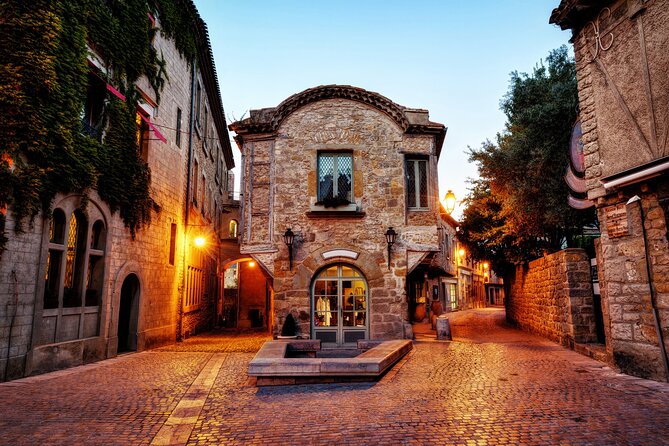
Reviewed · CARCASSONNE DAY TOURS
Medieval Carcassonne: Interactive Ghost Story & City Game
A phone turns Carcassonne into a live mystery. This interactive ghost story city game has you walking real medieval streets and answering clue-based questions that reveal the city’s darker past. You play in English with the Questo app, and you can start and stop whenever it fits your day.
I like the format for two big reasons. First, it is self-paced: start when you want, pause as often as you like, and come back later without losing the whole day. Second, the route pushes you to look closely at specific landmarks, from Square Gambetta to the ramparts and onward to Château Comtal, instead of just following the main postcard path.
One real consideration: the whole experience depends on your phone and getting the game started correctly. If your battery is low or your app setup is slow, you may lose time at the beginning, so bring a charger mindset and follow the on-screen steps closely.
In This Review
- Key highlights worth your time
- Square Gambetta to Château Comtal: a medieval walking game, not a bus tour
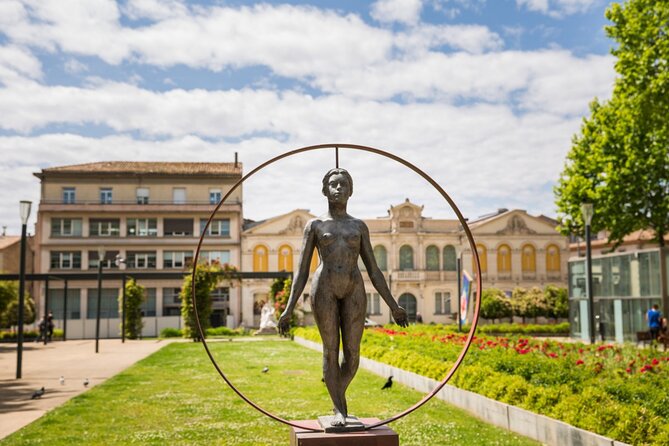
- Setting off from Square Gambetta and the Bastide de Saint Louis
- Notre Dame de la Santé: plague memory in a tight passage
- Pont-Vieux area: the Manufacture Royale story behind the facade
- Saint-Gimer Church and the feel of controlled modesty
- Porte de l’Aude: the gate that overlooks the river
- Inquisition Museum and the Romanesque cathedral: when the story gets heavy
- Château Comtal finish: the fortress built over Roman walls
- Price and value: $6 for a self-guided mission with real stops
- Tech reality: how to use the Questo app without wasting time
- Who should book this medieval Carcassonne ghost story game?
- Should you book Medieval Carcassonne: Interactive Ghost Story & City Game?
- FAQ
- How long is the interactive ghost story city game?
- Can I start the game at any time and pause during the walk?
- Do I need a physical guide with this experience?
- What language is the game offered in?
- How much walking is involved?
- Are entry tickets to monuments included?
- What is the meeting point and where does it end?
- Is free cancellation available?
Key highlights worth your time
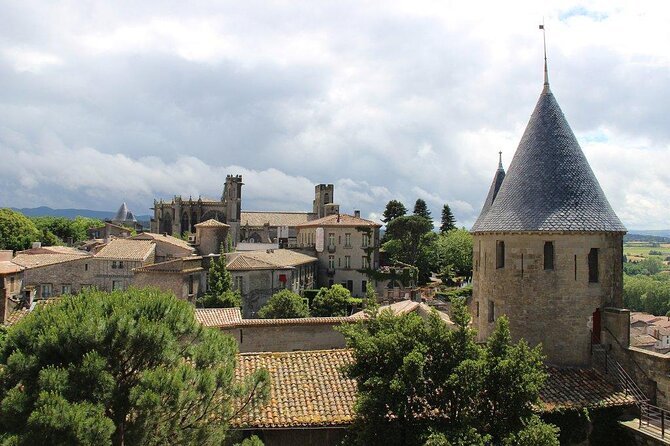
- 10 interactive puzzles over about 3 km across the medieval citadel
- Start anytime, pause and resume using the Questo app
- Real stops with real stories, including plague-era sites and the Inquisition Museum
- No group chaos, no guide script since it is contactless and private
- Ends at Château Comtal, a natural payoff after the walking and clues
- Entry tickets are not included, so plan for any museum costs separately
Square Gambetta to Château Comtal: a medieval walking game, not a bus tour
Carcassonne is one of those places where you can spend hours just staring at stone. This game turns that instinct into a mission. Your phone guides you step by step, and your job is to find the answer to each challenge by looking at what is right in front of you.
The path is designed to move you through the older, walled heart of the city. You will cover about a 3 km route with 10 puzzles, and the whole thing takes about 1 hour 40 minutes at a comfortable pace. It feels doable for most people because you can stop whenever you want, step away for photos, then jump back in.
The end goal is Château Comtal, the fortress linked to the city’s medieval rulers. It is a satisfying closer because you finish at a place that looks like it belongs in the story you just learned. If you want a hands-on way to see Carcassonne beyond the obvious, this is a good match.
More Carcassonne visits:
- Carcassonne: Castle and Ramparts Entry Ticket
★ 4.6 · 2,884 reviews - Toulouse: Carcassonne Day Trip by Coach with Audioguide
★ 4.4 · 580 reviews - Carcassonne During World War 2
★ 5.0 · 127 reviews
Setting off from Square Gambetta and the Bastide de Saint Louis
Your first steps come from Square Gambetta, across the Aude River from the main Cité views. This square matters because it marks the start of the older walled city area tied to King St. Louis and La Bastide de Saint Louis. That is a clever way to begin, because you get the sense of “this was built on purpose,” not just “this is pretty.”
The game starts with a scavenger-style challenge. You have to look around to find the answer and then move on to the next location. That sounds simple, but it is the key to making a phone experience feel like city walking, not staring at a screen.
If you want the best rhythm, do this early in your day when you still have energy for small details. The clues work best when you slow down enough to read inscriptions, notice placement, and connect the stone you see to the story you are hearing through the app.
Notre Dame de la Santé: plague memory in a tight passage
Next up is Notre Dame de la Santé, a small chapel tied to the plague years. The chapel was funded in 1527 through the legacy of Jean de Saix, and it served as a hospital for those suffering from the plague. The location is described as strategic because it sits in a narrow passage between fortified buildings.
This is where the game’s “look harder” style pays off. You are not just told a tragedy happened; you are directed to pay attention to the site itself. Standing in a narrow passage between fortified structures changes how you imagine how people moved and survived.
One smart way to approach this stop is to keep your expectations balanced. The game’s theme includes medieval persecutions and dark chapters, so if you are traveling with younger kids, you may want to preview the tone and then judge how much your group can handle in one sitting.
Pont-Vieux area: the Manufacture Royale story behind the facade
At the foot of the Pont-Vieux, on the right bank of the Aude, the game leads you to a facade that points to Carcassonne’s prosperous periods. The building was once a noble family home, then bought in 1694 by someone close to Colbert, who founded a cloth factory there. In 1696, that factory received the title Manufacture Royale, and the only building from that specific period still visible is the owners’ residence.
What I like about this puzzle stop is how it shifts the mood. You go from plague and suffering to work, production, and civic wealth. It is a reminder that cities do not only live through wars and disasters, they also live through everyday systems like cloth making and trade.
Again, you will solve the clue by looking around. This is one of those moments where people who speed through sightseeing often miss the payoff. If you treat each facade like a puzzle piece, the city starts to feel more “designed” and less “randomly old.”
Other Carcassonne bookings to consider
- Private guided tour of the city of Carcassonne
★ 5.0 · 58 reviews - Carcassonne: Medieval Builder-Themed City Tour with a Guide
★ 4.9 · 57 reviews - Carcassonne: 1h30 Walking Tour of the Medieval City
★ 4.7 · 44 reviews - Guided tour of the City of Carcassonne (on foot)
★ 5.0 · 26 reviews
Saint-Gimer Church and the feel of controlled modesty
The walk continues to Saint-Gimer Church, built between 1854 and 1859 by architect Eugène Viollet-le-Duc. The design goal included modesty, and the building has a nave and two aisles. It also includes a polygonal apse placed on two vestries, plus a porch at the front.
This is a good stop to slow down and notice proportions. Viollet-le-Duc is a name many people associate with restoration, so it is interesting to see how his design language shows up in a church that emphasizes restraint. The app’s challenge style helps you look past the big silhouette and notice layout choices.
A possible drawback here: if you were hoping for more “ghost story drama” at every step, this stop leans architectural. It is still part of the overall narrative, but it is more about structure than scares. If that is your preference, you will likely enjoy it.
Porte de l’Aude: the gate that overlooks the river
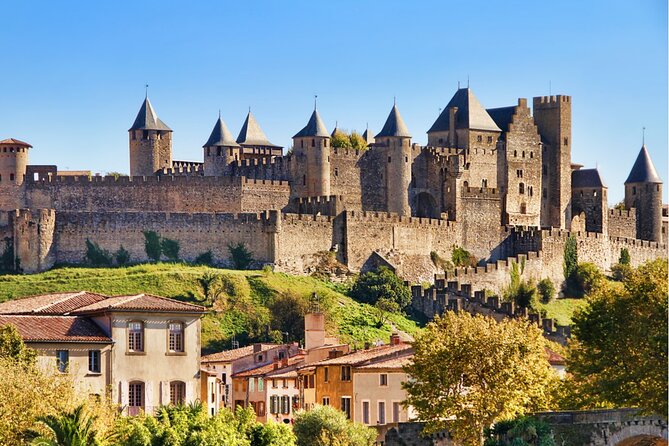
Then you reach Porte de l’Aude, an iconic medieval gate that looks over the river. It is one of those places where you can feel the logic of fortifications: people and supplies would funnel through specific points. From here, the city reads like a defense system, not just a historic setting.
The game’s puzzle approach at this stop is simple but effective. You have to look around and answer based on what you see at the site. That means you get a practical skill out of the walk: learning how to identify key features of a walled city by sight.
If you visit in warm weather, this is also a place where you might want to take a short break. It is exposed, and the entire experience involves time on foot. Use that pause to hydrate and reset before the next darker section.
Inquisition Museum and the Romanesque cathedral: when the story gets heavy
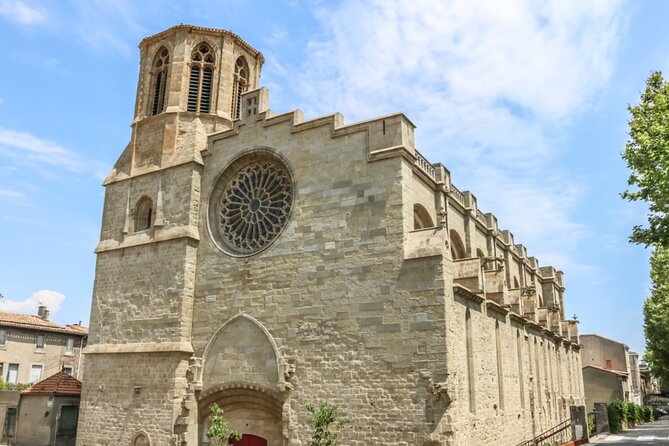
Next comes the Inquisition Museum, housed in a large 17th-century building. The focus is on instruments of torture, described as ranging from the 12th century to the French Revolution. The museum experience is also said to include characters involved during this period, their biographies, and the wider history of the main Cathar castles tied to the Inquisition and regional story.
A key practical note: monument and attraction entry tickets are not included in your $6 game price. So if the museum draws you in, you will need to budget extra for admission. That said, the game’s stop at the museum helps you frame what you are seeing, rather than walking in cold.
After that, you head to the cathedral story. The Romanesque cathedral work began in June 1096. A Lady Chapel was added in the early 15th century, and the complex also includes earlier religious spaces such as an infirmary and a chapel built by Bishop Radulph in the 1260s.
This part of the route makes the whole experience feel balanced, even with the heavy theme. You move from a museum that documents cruelty into a sacred architectural timeline that shows endurance and rebuilding. If you enjoy connections between art, power, and faith, this segment is worth the effort.
Château Comtal finish: the fortress built over Roman walls
The game ends at Château Comtal, which was built in the 12th century by Bernard Aton Trencavel over the western part of Roman walls. That detail matters because it ties Carcassonne’s layers together. You are not just seeing medieval stone, you are seeing medieval stone built on older foundations.
Finishing here feels like a payoff for your phone-led detective work. You have been solving questions across chapels, gates, and churches, and now you arrive at a place built to control people and territory. If your group likes dramatic architecture, this is the moment that makes the whole walk click.
One more tip: keep your phone charged through the end. Since the experience is mobile-based and you are following step-by-step guidance, running out at the finale is the worst possible timing. A small power bank can save the day.
Price and value: $6 for a self-guided mission with real stops
At $6 per person, this is priced for value, especially in a city like Carcassonne where many “experiences” quickly become expensive. You are paying for a phone game that structures your walk, gives you local stories, and builds in flexibility.
The good value part is not just the price. It is also the structure: 10 puzzles across about 3 km, plus a route that takes you to meaningful stops like Porte de l’Aude and the Inquisition Museum area. And because it is private and contactless, you do not have the friction of matching a group schedule to a guide.
Two ways you should adjust your expectations. First, attraction entry tickets are not included, so museums or monuments you choose to enter will cost extra. Second, this is not an audio-only narration where you can casually wander without looking. The challenges ask you to scan details, so you have to be willing to use your feet and your eyes.
If you like doing one active “thing” each day, this could easily be a highlight rather than filler. It is also a strong option if you want something more engaging than a self-guided walk but cheaper than a guided tour.
Tech reality: how to use the Questo app without wasting time
The experience runs through the Questo app, with a mobile ticket and step-by-step guidance to Château Comtal. It is available in English, and you can start at any time. You also get the benefit of pausing and resuming, so you can break your walk without restarting.
Here is how to make it smoother in real life. Arrive at Square Gambetta with your phone charged, your app installed, and your attention on the first instructions. Some people run into trouble at launch, so treat the start like a warm-up, not a moment to multitask.
If anything goes wrong, you can reach support. The provided contact info in this experience’s support responses includes in-app chat available 24/7 and emails such as [email protected]. If your quest access fails, message them quickly rather than trying random QR iterations for an hour.
Also consider battery management. The walk is about 1 hour 40 minutes, but puzzle games can stretch longer if you pause often. Bring a charger if you are the type who takes lots of photos and reads everything in detail.
Who should book this medieval Carcassonne ghost story game?
This is best for travelers who like hands-on sightseeing. If you enjoy puzzles, noticing architecture, and letting a theme guide you to less obvious spots, you will probably find it fun and motivating.
It can also work for families as a lighter “history moment,” especially when kids are willing to follow the game rhythm. That said, if your group includes kids who lose patience with looking-for-answers tasks, you might end up splitting attention. In that case, plan to treat it as a choose-your-moments walk rather than a strict timed challenge.
It is also a good fit for couples and solo travelers who want a private experience without waiting on others. With group discounts and the ability to book multiple times for larger parties, it can work for small groups too.
If you want a classic guide-led tour with explanations delivered out loud and no phone use, this is not that. The experience is built around the app and the puzzle answers, so the phone is part of the product.
Should you book Medieval Carcassonne: Interactive Ghost Story & City Game?
Book it if you want an active, budget-friendly way to explore Carcassonne’s citadel with a story hook. The value at $6 comes from real route structure, 10 on-phone puzzles, and the chance to pause and resume as you go. I also like that the stops connect to specific places like Notre Dame de la Santé, Porte de l’Aude, and the cathedral timeline that began in 1096.
Skip or think twice if you know you struggle with app-based starts or you hate tech friction. The experience depends on getting the game running properly and staying charged. And if you are mainly after monument interiors, budget separately because entry tickets are not included.
If you do book, go in with a simple game plan: charge your phone, read the first steps carefully, and be ready to look closely at stone and facades. Do that, and Carcassonne turns from a pretty city into a walk with answers.
FAQ
How long is the interactive ghost story city game?
The experience takes about 1 hour 40 minutes on average.
Can I start the game at any time and pause during the walk?
Yes. You can start at any hour and pause and resume later using the app.
Do I need a physical guide with this experience?
No. It is a private, contactless experience with no physical tour guide.
What language is the game offered in?
The experience is offered in English.
How much walking is involved?
It includes 10 interactive puzzles along an approximately 3 km route.
Are entry tickets to monuments included?
No. Entry tickets to monuments or attractions are not included.
What is the meeting point and where does it end?
It starts at Square Gambetta and ends at Château Comtal.
Is free cancellation available?
Yes, you can cancel for a full refund if you cancel up to 24 hours in advance of the experience start time.
Newly listed around Carcassonne
- Winery Visit with Food and Wine in Carcassonne★ 5.0 · 59 reviews
- Private guided tour of the city of Carcassonne★ 5.0 · 58 reviews
- Guided tour of the City of Carcassonne (on foot)★ 5.0 · 26 reviews
- Cité de Carcassonne Guided Walking tour. Private tour.★ 5.0 · 42 reviews
- Carcassonne ‘s Medieval Walls: A Self-Guided Tour★ 4.5 · 43 reviews
- Languedoc: Tour and Tasting at Domaine de Baronarques★ 4.8 · 64 reviews
- Carcassonne: Medieval Builder-Themed City Tour with a Guide★ 4.9 · 57 reviews
- Carcassonne: Fortress Walking Tour★ 5.0 · 24 reviews
Carcassonne Day Tours, compared.
Carcassonne: Castle and Ramparts Entry Ticket
Read our review →
Carcassonne: Private Guided Tour of the Medieval Fortress
Read our review →
Languedoc: Tour and Tasting at Domaine de Baronarques
Read our review →
Browse the lists this tour appears in